Thursday, May 29, 2008

Mortgage For Quote: National Irish Bank, Impermeable, Bank of Ireland a Case Study In Customer Care Excellence.

There is absolutely nothing like personal experience to bring home just how important customer care is to actual business profit. Before I start / rant, let me tell you that good mortgage enquiry leads can be worth up to €50. I have had mortgages with two banks previously. NIB and BOI. I phoned my former account manager at Bank Of Ireland (Anne McNamara) and said I am interested in getting a quote. "No problem" she replies, "but I work in Business Banking now, so let me see if I can find the right person for you to speak with". I gave her an incorrect name for the person I had been dealing with last time in Mortgages, but again no bother: she found the person we were dealing with, and called us back in 5 minutes with two other contact names that would take our call in the next 30 minutes. Thanks Anne, that's great, and you know, I like speaking with you, and I feel better about working with your Bank.

Cue Bad Guy Music: NIB have a general low call number on their site (yes, not free, lowcall). I phone, it puts me through a useless IVR, and never offers to connect me to a named service (duh, Mortgage Enquiries?). I get fed up, and hang up. FAIL. Feel guilty, maybe I was wrong. Search the intertube for any reference to a local NIB Branch number in Limerick, you know, so I could call the branch and book a meeting to talk about a MORTGAGE ! (Holy cow). Can't - find - a - way - through - must- try - harder... ah to hell with it.

Then an email comes back (I'd fired one off earlier to our account contact in the local branch) and its "I'll call you tomorrow". Great, I'll talk to you after a meet the nice people from BOI, have drunk their tea, and generally got friendly with. Hey, maybe they will come up with some great insights, and be able to get the ball rolling so I can close down my bid really fast. Wouldn't that be great.

The Take Away:

- Make it easy for your customers to reach the people they do business with, within your company;

- Use Click-To-Call intelligently, a "mortgage search query" should pop up a local number to call;

- Understand Context: I have signaled to both institutions in various ways that I was actively looking to make a house purchase, why is this not ticked?

Tuesday, May 27, 2008

Dirty Small Bad Things:)

I follow quite a few of the "new media guys" and they often come up with great insights that I can keep in my deep back pocket when looking at the enterprise2.0. Darren Herman is one of these guys, but I was a little surprised to see that one of his "habits" is to leave the phone on silent and only check it a few times a day. The interruptions are just too disruptive. If people really want to find him, and get in contact, they have to be "creative". I think Darren may be a maven in this respect (i.e. early social media adopter), but it does point to a central question: "if it's important, the request will find me".

It's a variation of Tim Ferriss's "let small bad things happen", because you don't need to manage every little thing. What is really happening here though is that Darren is screening his calls, and (from the outside) this has some embedded rules:

- if your caller ID announces you, I can choose to take call or not

- I have voice mail, so you can choose to leave a message or not

- I can choose to call in, and action as I wish.

- If important, there are other "hard to find" / "insider routes" to finding me.

eh hum. Small point. It's the little things that really drive customers mad. If you don't find a way, and have a system for ensuring that the small things don't get picked up on quickly, you are going to lose some of our customer good will.


water

Speaking of small things, Rob Patterson over on the FastForward blog points our attention to the corporate use of Twitter over at Zappos. They have a directory of all the employee Twitter-streams, that way employees can connect with each other, and connect with customers. It's leading edge for certain. But then GetSatisfaction use Summize to bring the twitter and social media back to the place where people are seeking to make contact with others around this complaint or praise. Zappos wants you to call them, you will develop some relationship with them, and ultimately buy more (their growth is stellar). At VoiceSage we think that how you handle the "exceptions" is a real opportunity to create customer satisfaction value.

And then I put out a Twitter saying what a great idea this corporate twitter directory was. And the CEO of Zappos "added a follow" , i.e. "we're listening".

Thursday, May 22, 2008

Recently Insolvent Companies

This just in from the Irish Institute of Credit Management (IICM) Newsletter:

(Quoting) IDS Collections survey from Credit Today, where they surveyed credit management in the final 6 months of 100 recently insolvent companies –

97 had not taken any action against debtors –        
92 had received no payment since oldest invoice –        
50 continued to supply customers with debts of over 90 days        
40 of the 50 doubled the customers indebtedness

I particularly like the reason the recently insolvent companies gave for allowing this stage of affairs to continue:

"we wanted to maintain good relations with customers"

Datability: Is it time for you to build on your own data?

"If the economy continues on a path that looks like a recession, consumers are going to tighten their belts even further. More and more of a consumer’s household income is now going to simply servicing current debt. The credit crisis will guarantee that this will go on for awhile longer given the bad debts on many lenders books".

consumerdebt

Source: www.mybudget360.com

So, with all this spiraling debt, how come our inflation figures aren't even higher? According to this interesting site, the US Government is looking at inflation as something more long term, something that doesn't want to too heavily weigh Food, Energy and Health Care costs. Not only that, but there is an interesting discussion on how the Government calculations of "rent equivalent" valuation of housing stock, significantly underestimated how much the average person way paying out at the end of each month., i.e. they are underestimating the actual disposable income. 

 So what's my point?

(1) Information should be based upon data that you understand, that you have an informed understanding of, such as the nature of the "inflation figure" you are using;

(2) Using "big block" figures removes nuance, and nuance is the day to day stuff that gets you operational efficiency (of course nuanced data requires flexible reporting capability);

(3) By digging into your data and acquiring better data, or even better still by encouraging customers to exposure their data to you, or co-create data, you can come to a real estimation of risk (in this example mortgage payment risk).

(4) Nuance gives you the opportunity to re-segment and gain insight.

(5) New insight create the opportunity for new Interaction patterns.

At VoiceSage we have reason to work with quite a few companies on issues such as late payments on personal loans, on mortgages etc, and mostly these customers have very professional systems and organisations for addressing these issues. I just wonder how much nuance is being lost by taking "data" at face value, and how much more "nuance" might be able to add value.

Wednesday, May 21, 2008

Theme-Synchronicity

Yesterday, I just went off on one about customer interaction patterns, and how online and offline behavior's weren't so traceable, and weren't so simple. Today, Patty Seybold has a timely reminder that there are three different customer lifecycle scenario's: I really like them because each one gives you some good framing to work within, and then match to your online / offline activities:

  • Customer Lifecycle Customer Scenarios. These are closely connected to customers’ discovery, acquisition, and use of your products to fulfill a need they have. How do customers ideally want to interact with your brand and your ecosystem through their product lifecycle?
  • Event-Triggered Customer Scenarios. These relate to life events or business events that customers need to deal with. For consumers, these might include buying a new home, retiring, welcoming a new baby into the family, sending a child off to college. For business people, these scenarios may include things like launching a new product, opening a new branch, or downsizing the business.
  • Outcome-Based Customer Scenarios. Some scenarios are focused on a specific outcome, such as losing 20 pounds, getting a promotion, or increasing your revenues by 20 percent while retaining or improving your current profit margins.

Just to take the second point there, "event triggered scenarios". If a chronic late payer has received messages from your organisation attempting to engage them in conversation around that commitment, wouldn't it be interesting to know that their house was up for sale? That their car was at auction etc. That scenario could be delivered to you via some interesting mashup's.  Indeed, if 20 other properties within "x" distance, or within that post code had gone up for sale in the last quater, this may influence how you wish to treat the customer debt (i.e. it really is in danger of going delinquent).

Tuesday, May 20, 2008

The Buying Process Isn't Straight Forward

Bruce Temkin of Forrester points out that customers want face to face interaction. 45% prefer to speak to an agent over the phone, than other ways such as FAQ, self service, etc. In our book, the question thus becomes how can you enable the "best way" for your customers to contact you? Publishing a click-to-call button is surely a good "invitation to conversation", but so is just giving the customer a call when you know they are likely to want help. How many calls do you usually get because part A does not in fact slide easily into part B? There are different points in the customer interaction process where they will want to speak with someone, make it easy, and make it a great experience.

A related question is how to link all lead generation activity from "leaflet drops" to "adsense" back to actual purchase activity, and measures of customer loyalty  is a current holy grail of many companies. Right now what we have is the fallacy of the "last click" (i.e. the last place we clicked in from is the reason we are at amazon, dell.com, etc.). It's not. A friend might have recommended that we check out a review site, a comment there might have brought us to a blogger, who recommended that we check out his story on zdnet.com, after which we clicked through to that computer etc. YET, (play drum roll here) Pew Internet Study found that over 20% of Americans have never even used email.

Something is broken here.

Lets Look A Bit More At This Pew Report

For those who have bought music in the prior year:

  • 83% say they find out about music from the radio, the television, or in a movie.
  • 64% say they find out about music from friends, family members, or co-workers.
  • 56% say they find out about music through various online tools, such as going to a band’s or artist’s website or streaming samples of songs to their computers.

Among those who have purchased a cell phone in the prior year:

  • 59% asked an expert or salesperson for advice.
  • 46% go to one or more cell phone stores.
  • 39% use the Internet.

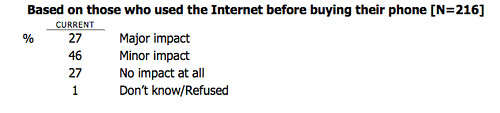
The “bottom line” conclusion is the following: “Even though many buyers use the Internet in product research, relatively few say online information had a major impact on the product choice they eventually made. Only 7% of music buyers, 10% of cell phone buyers, and 11% of those who bought or rented a home in the prior year say that online information had a major impact on their decision.”
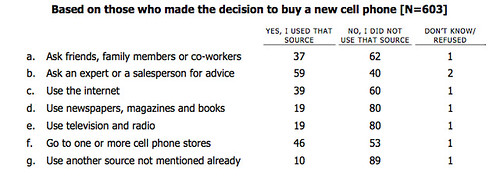
Pew cellphone source

Pew cellphone impact

So, yes the Internet is a really important research and comparison tool, FOR SOME DEMOGRAPHICS, but not for all. Many will look to the lead user/gatekeeper in their social circle, and there are indeed many interpolating influences at work here. The question I would pose for you and your company, is do you have a real roadmap and activity sheet to build out a clearer understanding of how your customers make decisions?

I'm guessing not, so something is broken here.

I can't leave this subject without also highly, highly recommending that you read this post from Greg Sterling, at Screenwerk. I too have been following NearByNow for quite a while, and the "killer app" behind their service (which I would have strong recommendations to change) is that the current "dark data" of unsearchable inventory in a retail shopping center is exposed, and becomes searchable. This is a mapping and melding of the physical and the digital in a way that enriches both. These kinds of services have the potential to radically change the nature and flow of the buying process.

Now Why Don't Credit Cards Do This?

The ever excellent Nudge blog points out that your credit card limit should not be a "de facto" blunt instrument. Why can't we set our limits for specific purchases, god knows, I need something to double check with me if I really want to buy those books :) Set your own credit limit for each category of purchase. Now that's some neat thinking. Why not have a little routine that you have to go through in order to validate what might be a impulse buy (i.e. if I buy anything over $100 please read out my credit card balance before authorizing my purchase!). What I love about this idea, is that people could customise and mashup what, right now, seems a pretty lame process.

So, Services Can Be Mashed Up For Personalisation? Duh.

If you are wondering about "Google Think", look at all the cool things you can do with gMail. Why am I such a big fan? Because Google Mail "atomizes" and "API's" everything, and that opens up the opportunity for innovation. Its "customer driven mashup" by any other name. Take the NearByNow example above, why could you not ask for "show me every store that sells Levi jeans for men" and have it on a "live map" (i.e. as the special offer jeans sell out, the count goes down in real time etc. etc.).

To follow the theme Dion Hinchcliffe is developing some excellent diagrams to help people understand what this landscape looks like at this point in time.

mashup_landscape

PersonalInfoCloud blog also has some interesting thoughts on how to visualise this landscape. A link to that diagram is here.

My take away, is that the people familiar with technology, our 2.0 crowd, will see, use and abandon services with great regularity. Some will stick. Those that show real capability of getting scale will be bought by those that can distribute, i.e. the big installed players.

In a final note, I was sad to hear that KnowNow are to cease trading. It was a great idea. I think it just needed a "bigger home".

Tuesday, May 06, 2008

Forrester Mash Up To Be Worth $700m

VoiceSage provides Interactive Voice Notification in the Process Layer of the Diagram above. Its not easy, but we hope it's simple. More detail on the excellent, as usual, ReadWriteWeb.

Technorati technorati tags: , , , , ,

All Companies Are "Collaboration Nets"?

Some notes coming in from Sapphire 2008, SAP Conference: (HT: Paul Greenberg) Cisco: The future of business is collaboration....(John Chambers, CEO) SAP: The future of business is business nets...(CEO of SAP) RSS: Attention and Use, and what your colleagues are using, should influence what is presented to you on your own desktop.(HT: Jeff Nolan) Thought: To see this on a macro macro level, John Hagel, Edge Perspectives, Creation Nets. Oh, so what's this got to do with "customer interaction". Friend, its all about how you create and manage interactions.

Technorati technorati tags: , , , , ,

Late Payments In Europe.

Lots of things to talk about out there. Inside ARM cover a piece on Debt Payment Practices in Europe. Once again it goes to show that "one size fits all" probably doesn't work in Europe. It also brings home the need for good credit checking.

Technorati technorati tags: , , , , ,

Monday, May 05, 2008

Twitter

Twitter.com, the meme of the social computing world, is seen by others as an actual test of many of the theories at work in the whole social computing, social networking world. It generates around 20 times more traffic from API's than from the site itself. Paul Greenberg gives us a little tour of how those in the CRM and Publishing world are currently using Twitter, and you have to think that for Twitter this is half the battle. Expect to see the Twitter embedded in mainstream apps in the near future.

Technorati technorati tags: , , , , ,

Tuesday, April 22, 2008

Telco2: In Brief Review

Telco2 4th Executive brainstorm was last week, and it was in London, and it was some fun. It was also a little worrying. Thomas Howe did a great job of summing up over on Alec Saunders SquawkBox Perhaps it is a problem of "big numbers". There is still money in connectivity and IT outsourcing. The Telco's can't seem to get their heads around how to get started, and even it's worth doing. How to and why they should expose API's is an unknown. And these are some very big numbers, it is perhaps difficult to get excited. Now a bit of a drum roll please.... VoiceSage announced that a major study had come in from a large client showing an 800% overall improvement in the processes enabled by VoiceSage. Uh hum. Yes. VoiceSage brought their cash in 100% faster and the cascading effects of this were significant. So when I was saying we can make dramatic offers, I wasn't joking. Now here is the kicker: "Every $1 spent with VoiceSage makes or saves you $12": again, validated. So what's with the big diagram folks? (HT Dion Hinchcliffe) The Web and the Company will mash together. The ease with which this is possible has the potential to release a lot of new data, and create a benefits that are orders of magnitude above what current IT deployments are able to achieve. Oh and as I was at Telco2, Dion and his crew were building, in realtime, applications within the new Google hosted development environment. So, under the floor boards, the ants were already swarming. So, I can build an application in the cloud, host it in the cloud, scale it in the clowd, and promote it through Google, and manage the logistics of delivery through Amazon. That's cute. And what do Telco's do? We do what we always do, we provide you with connectivity........

Technorati technorati tags: , , , , ,

Monday, April 14, 2008

Telco2, London

Well, we are off to Telco2 in London on Wednesday and Thursday and presenting on the area of Communications Enabled Business Processes, i.e. how Interactive Voice Messaging can be used by regular business to drive results. It is pretty well attended by the Telco and Telco vendors, but one of the absolute reasons everybody should check it out, is their vision of the Two Sided Platform. The blogging will be in pause for probably a week, but as per the world of modern media I hope to post some twitters on interesting opinions as they emerge over the course of the two days. If you want to follow me, I am on www.twitter.com/PaulSweeney

Follow up those forms with a phone call!

DestinationCRM.com reports that a simple phone number on the webform can increase customer contact where good "follow on" leads to sales. So, either put your number on them there forms, or follow on with a phone call over times certain forms get filled out. You could lift your sales by circa 10% (apparently). The key thing is you have to make this contact happen within the first 30 minutes. response rates are much better in that time frame because people are still thinking about that issue and willing to engage. From elsewhere on the web last week someone asked "what's the number one predicator of bad customer service?" Ans: "They don't put their phone number on the website".

InsideARM point us towards an Aberdeen Research report that says the best performing collections agencies focus on  shift scheduling processes to that you can adjust staffing levels to meet actual demand. It makes sense, but the question is of course how do you manage demand as well? Outbound Interactive Voice Messaging can be used to completely eliminate many different types of inbound call, and can also be used to dramatically (yes, we have numbers to validate this!) improve your agent productivity vis-a-vis a regular auto-dialer. The rest of the points were as follows:

Focus on Training is also important: Agent training and coaching provides agents with the necessary skills and support system to properly utilize new product releases, tools and practices. More than half of best-in-class firms use e-learning to improve agent performance; another 39 percent employ periodic agent testing; 36 percent use issue resolution workshops; and 36 percent employ self-paced training.

Knowledge Management: Analytics is a key component of any workforce optimization suite because it provides the cornerstone to understanding the current and historical state of contact center activities.

Updated Technology: To optimize workforce utilization, a contact center needs integrated technology with multiple components. Forty-one percent of best-in-class companies have implemented workforce optimization suites.

Performance Management: Best-in-class companies that use workforce optimization solutions see increases in key performance management. Performance management solutions help companies improve sales or improve collections on outstanding invoices, according to the report.

Friday, April 11, 2008

Who Answer's The Phone? Who Answers The Missed Calls?

Lots of interesting themes linking up this week. So this is a post in two parts: Seth Godwin asked why most organisations are so "careless" about who answers the phone?
"Shouldn't every single inbound call be answered in one ring? Shouldn't there be as much spent on self-service customer support as is spent on the design of the selling part of your website? Shouldn't you be tracking in the finest detail what people have to say when they call in? Shouldn't you be rewarding call center operators by how long they keep people on the phone, not how many calls they can handle a minute? Shouldn't there be an easy, fast and happy way for an operator to instantly upgrade a call to management (not a supervisor, I hate supervisors) who can actually learn something from the caller, not just make them go away?"
Calls coming into any business can be analysed for underlying causalities. Seth wanted to say "hey, your product changed and I don't think that's been in a good way". Basically he wants to help you develop a product that appeals or re-appeals to the people that made your brand successful in the first place. Offering him another bar (of the same) chocolate is obviously lame. Routing him through to "Frank, our chocolate mixing guy", might seem weird at first, but hell, why not? Frank gets to talk to a customer and connect with a customer, with someone that actually cares about his part of the product development. At least, everybody will have an intelligent conversation. Of course its hard to have this conversation in the first place if you don't answer the phone. Ever heard the phone ring out in your office? Bet you have. Bet you have no way of knowing if it was important or not either. So the first take away: perhaps even more time should be spent in matching inbound callers, and their inbound calling contexts, to actual agent skills. I know this topic isn't new, but so few companies seem to be doing this well IMHO. And now to our second, related point: Jim Gilbert is a marketing guy at eDiets and has a lot to say about marketing and customer service in the catalogue industry. To speak to the issue at hand, when the phone rings in this environment he believes that their are four types of prospect inbound call outcomes: 1. calls answered where an order occurs; 2. calls answered where an order doesn’t occur — contact data captured by the customer service rep (CSR); 3. calls answered where an order doesn’t occur — contact data not captured by the CSR; and 4. calls not answered where no order occurs (calls abandoned). Jim, then goes on to give some ideas on how you might respond to scenario 4 in particular. In this scenario Jim reckons that you can do a "reverse look up of the ANI (automatic number identification) and perform a match up of that number with an address. The success rate of such match up's is about 30-40%. Similarly, you could also just send a "missed call interact" from VoiceSage and give the customer one of the 3 known reasons why they were calling (i.e. were you calling to order a catalogue, if so press 1, and then get them to confirm their address. If the address is incorrect hook them back to customer service and get the correct address). Simple. And hey, if you do this kind of thing really well, you will probably be very easy to contact if anything does ever go wrong with the service or the products you buy from this company, thus increasing my likelihood of buying. So take away 2, is the same as take away 1: even missed, dropped calls can be re-engaged with through good forward planning.

Technorati technorati tags: , , , , ,

Wednesday, April 09, 2008

All Behaviour Is Incentive Lead.

Customer behaviour is an interesting thing. That's why I read Gerard O'Neill's blog Turbulence Ahead, Seamus McCauley's Virtual Economics, and Tyler Cohen's Marginal Revolution. What do these have in common? They all take a micro-economic view of human behaviour in that people are basically, incentive led. The problem, is that we don't build the right incentives. I was much taken to day by a lead provided by Gerard to Nudges where they show examples of where small "nudges" to your behaviour can have dramatic effects. One trick is to put the "nudge" near a decision point: for instance, putting a sign "why not use the stairs" near the elevator increased use of the stairs by 200%. Marketers have known this for a long time but it still makes me wonder why we don't always put the right information or action choices near key decision points. If someone is late paying their bill, they know they are approaching a late fee, they are often making a decision to "not pay", to "forget to pay", to "re-prioritise" payment options. You can send a call / SMS / Nudge to them and just remind them that this is a decision point, and that it has consequences. I am also thinking about how all these "nudges" and "micro-incentives" could work in terms of social media. Given the liquidity of digital environments, it has to be a huge new area.

Technorati technorati tags: , , , , ,

Tuesday, April 08, 2008

A Gathering of Topics

I really like the idea of voice powered services particularly the idea of dialling your to do number, and getting things done. Irish company Dial2Do are doing just that enabling you to dial in and start sms-ing, emailing, and god knows what more. Check out Jott (for Blackberry :) and Pinger for examples of other companies that help you get things done with voice. From what I can gather with Dial2Do the guys in there are looking for all sorts of modes and streams to make and post to, but if rumour is true then the guys in spinvox not only have a cool Blackberry application that lets you "see inside your voicemail" by sending you an email summary, but they may be opening their whole TTS (text to speech) engine to all other applications as an API. Hey, the more people use it, the more powerful it becomes, great strategic move from SpinVox (if its true). UPDATE: of course I intended to mention SimulScribe, a leader in visual voicemail, and they have a full API for their solution. Ah, so why is this stuff interesting to anyone from an enterprise point of view? Well, how about putting systems in place so that customers can use these kinds of tools to "get things done" with you? Why do I need to speak with an actual agent, if I can just phone your company IVR and leave a Jott/2do/Vox? Ever leave a message with a bank's voicemail and feel no one listened to it, that maybe nothing is being progressed? Ah, yes. That's why we phone in again, right? Strikes me that enterprise companies can learn a lot from what is going on in the consumer field right now. And how people make decisions, compare options, make recommendations etc all changes with the net. Forrester's Charline Li pointed out to her "twitter followers", that they had released some details about how they were looking to measure "customer engagement" "Engagement is the level of involvement, interaction, intimacy, and influence an individual has with a brand over time. The four components of engagement are: Involvement— Includes web analytics like site traffic, page views, time spent, etc. This essentially is the component that measures if a person is present. Interaction— This component addresses the more robust actions people take, such as buying a product, requesting a catalog, signing up for an email, posting a comment on a blog, uploading a photo or video, etc. These metrics come from e-commerce or social media platforms. Intimacy— The sentiment or affinity that a person exhibits in the things they say or the actions they take, such as the meaning behind a blog post or comment, a product review, etc. Services such as brand monitoring help track these types of conversations. Influence— Addresses the likelihood that a person will recommend your product or service to someone else. It can manifest itself through brand loyalty or through recommendations to friends, family, or acquaintances. These metrics mostly come from surveys (both qualitative and quantitative). Our argument is that companies need to start tying these metrics together to make sense of how engaged their customers actually are—and then make product and marketing decisions based on that knowledge". I guess my "bridging point" here is that planned/ active interaction, and passive/ receptive interaction really need to be finely aligned, so that you communicate with your customers when they need it, and that you really listen, and make it easy for them to speak with you, when THEY need to. Services such as VoiceSage can really help you reach out, put in the "to-do", and manage the response/ action cycle. I don't think I'd be making any ground breaking comments to say that most organisations (at best) approach each of the 4 Forrester tenants of Engagement as point solutions, but for complete pictures, all 4 will have to be undertaken in an interwoven strategy.

Technorati technorati tags: , , , , ,

Monday, April 07, 2008

No Service Is Best Service?

Guy Kawasaki has a good interview up Bill Price, Amazon's former VP of Customer Service. I think I can boil this down a bit further: - Make your product unbelievably easy to use. If you make your customer look up FAQ's, or ring you up for "dumb questions", your product is inadequately designed; - How can you predict a company that's going to have bad service? Ans: They don't print their phone number anywhere you can find it! - Be proactive: give the customer the best price/value point you can "pro-actively" (ie. best value delivery schedule, best value product bundle, etc.) - Eliminate contact friction where it exists and is necessary, but with a view that you should be able to gather the information and fix the reason they are calling at root cause. Here are some follow on questions in relation to that point: 1. Eliminate dumb or avoidable contacts to free up capacity and slash costs. 2. Build self-service that works to free up even more capacity and cut costs even more. 3. Find ways to be proactive rather than reactive because it is often cheaper than waiting. 4. Engage the real "owners" of customer problems to work with the customer service team to fix the problems 5. Make it really easy to contact your business. 6. Use the contacts you get to listen closely to the customer, and act upon WOCAS (What Our Customers Are Saying) 7. Fix reporting metrics, processes, and the staffing side to deliver great experiences for customer contacts. And here is an interesting take on measuring customer satisfaction "The rate of customer-initiated contacts that require personal support is the best measure of satisfaction. This is expressed as "CPX," or "contacts per X," where "C" equals calls + email messages + chat sessions, and "X" equals transactions or installations or invoices sent. Measured and shared weekly, companies achieving Best Service see 20-40% per year reductions in CPX and as a result much happier customers and lower costs too. Our second killer metric is the rate of repeat contacts, or "snowballs." Just like the snowball rolling down the hill, getting bigger and menacing skiers, repeat contacts are clear "customer dissatifiers" that need to be stopped--or melted--before they ruin the company's reputation. CheckFree is a great example here: over the past five years their transactions have quintupled while customer support headcount is down 20%, at the same time that customer satisfaction rose by 20%". I haven't read Mr. Price's book yet, so I look forward to it.

Technorati technorati tags: , , , , ,

Friday, April 04, 2008

Passive and Active Participation For Customer Experience

Some good points today from Beagle Research today on the difference between Active and Passive customer experiences, and how to think about customer experience itself. Nic over at The Equtiy Kicker is zeroing in on why social networks will be important, even if they aren't making that much money now. Its been fun following Nic and his journey down the rabbit hole of social networking. Nic also has a post today on why SaaS (software as service) offerings like VoiceSage, may see an uptake during a recession. What have these posts got in common? Its the bridge between them. Social Networks can be passive or active, and the experience of being on a social network can be passive or active. Their benefits from and for both of these. Sometimes you just want to know when someone else "is going to attend that concert", because it tells you something about what they are interested in (which may be a false picture none the less); other times you value knowing this information because you too would like to go if this person is going, and you want to take action. Thus, Active. We have been using some of these principles internally for a while in explaining to people that SMS is Passive, and Voice is Active. When combined, you can achieve a cycle of interaction that has active and passive elements. You can also throw synchronous and asychronous communications and need for active and passive into the mix. Either way, their are many new ways into which companies can communicate online and offline, and the key will be having a joined up strategy for them all, but keeping "customer experience" dead centre.

Technorati technorati tags: , , , , ,

Monday, March 31, 2008

The Customer is NOT Always Right? Duh.

The customer is not always right?: or siding with your employees more might actually result in better customer service. Interestingly, this post drew over 250 comments after it was mentioned in the NYT. Alexander Kjerulf, of PositiveSharing Again, the question to ask might be "what's reasonable here"? and "how can this be made exceptional?" The example given in the piece is that one customer of southwest airlines complained about everything. When bumped up to the CEO, he said "Goodbye, we shall miss you". Perhaps, "I've called my friend over at Virgin Airlines, and they would be delighted to take your business, and as a parting gesture, we have transferred all your travel miles to Virgin so you can get off to a flying start". Might seem counter-intuitive, but I bet that word would have went around.

Technorati technorati tags: , , , , ,

So What's The Big Idea? Be Meaningful.

I had caught this post by Francois at Emergence Marketing, basically saying that how a customer interacts with your brand or service is your "UI" (user interface). Its an idea picked up by Piaras Kelly this morning as well, as he explicates his experience at Dublin airport. He also connects to a great slideshow on the new approaches to marketing that is worth checking out here. If your product is really great, it will be remarkable. People will want to talk to others about it. Fortunately, the internet is a great way to share these experiences. Some friend on his myspace/ facebook presence line says "hey, about to go out and buy new sneakers", another friend emails/sms's/calls and recommends a new asics/ nike/ adidas. Some of the examples given in the slides I think are a bit "old school" in that they are really examples of conspicuous or public consumption (i.e. products that you consume in public and have a brand messaging element). See someone using a cool new iPhone, they are a "tech person", an "apple lover", a "tech hipster". The TRULY great examples of products that are their own marketing, are the products that significantly make your life better. Umair makes this point over and over again. Do something that is culturally and socially important, that removes an unbalance, a barrier, an injustice, and you will be rewarded. Weirdly, when I go to think what's an example here Paul, the idea that looms largest for me is the use of Technology and Communications in the Obama campaign. The ability to connect, communicate, and mobilise using community, technology, and meaning, could actually re-engineer how our leaders get elected, and from there, perhaps how our public service relates to its public. That could be a pretty big structural change in the years ahead. If anyone has any other big ideas, please, let me know, I'd be happy to post them here, and give you the citation! update 1: just remembered www.headshift.com, these guys are bring enterprise 2.0 to the NHS (UK Health Service). Here is a great slideshire from them on bringing 2.0 tools to one of the biggest public service blocks. Update 2: Via Venterprisey (enterprise 2.0 blog) the use of mashup's to bring citizen based reporting on exit poles, intimidation attempts, murders surrounding the Zimbabwe elections. This inability to control the media message, may actually free a nation.

Technorati technorati tags: , , , , ,

Get your twitter mosaic here.